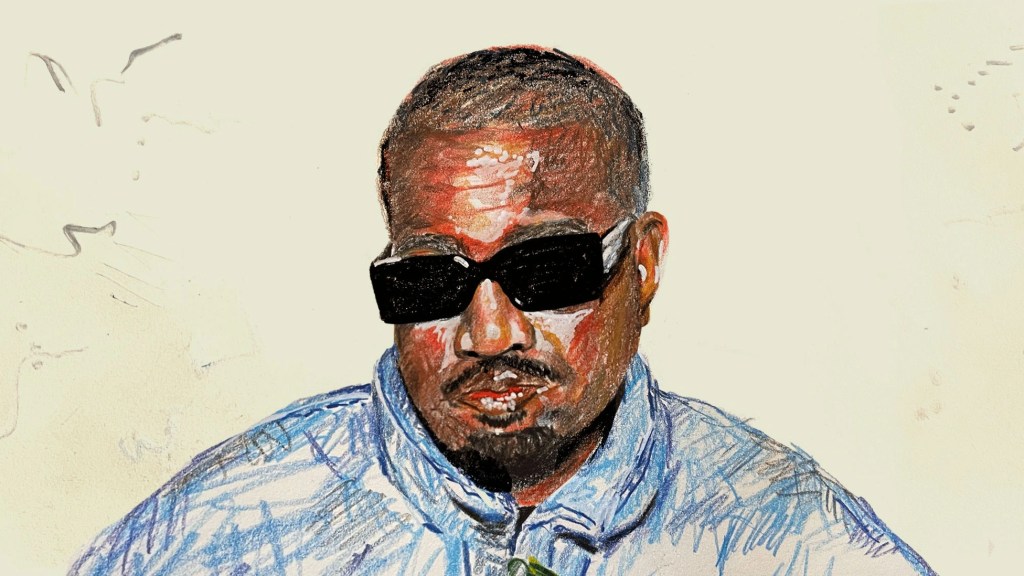
Agamemnon, Oedipus Rex, The Persians… we may need to add a name to the list of classic tragedies: Ye (FKA Kanye West). Ye’s evolution (if you can call it that) over the past 5-10 years has equally stunned and fascinated current and former fans of the rapper. At one point universally beloved for his role in modern hip-hop history, he now stands firmly at the center of debates about accountability, mental health, and the ethical obligation of artists and celebrities. Ye’s fall from grace is not simply a tale of hubris and celebrity disconnect, but rather a complex story of how the genius of one of our favorite artists unraveled into emotional turmoil. It’s important to think about what led to his decline and empathize with his personal struggles while still condemning his harmful statements and actions. Many also are forced to wrestle with the urge to appreciate his past work while still making their voices heard through consumer choice.
From Icon to Outcast
Ye’s ascension into superstardom was unprecedented. His rapping debut “The College Dropout”, released in 2004, was a breath of fresh air in the hip-hop scene, blending his already-acclaimed production with introspective, clever, and catchy lyrics that many didn’t know Ye was capable of delivering. The artistic catalog that followed cemented his status as a musical visionary, with many rap fans considering his three-album run of “Graduation,” “808s & Heartbreak,” and “My Beautiful Dark Twisted Fantasy” as the greatest three-album run in hip-hop history. Outside of his music, Ye went on to influence fashion and repeatedly challenge cultural norms, furthering his image as a maverick and visionary. However, aside from his successes, patterns of erratic and troubling behavior would emerge – most notably through a foreshadowing moment at the 2009 VMAs.
More recently, Ye’s trajectory has begun to veer into unsettling territory. His early endorsement of Donald Trump, the erratic and failed 2020 presidential bid that would follow, and his recent affinity for conspiracy theories and hate speech has taken him from provocative to problematic. This behavior came to a head through his intense anti-Semitism, which was met with almost universal outrage that led to severed business ties and an eroded and tired fanbase. The man who we once considered an eccentric genius has become a hateful pariah, with fans and onlookers left to pick up the pieces.
A Mental Health Crisis Unfolds
Ye has publicly acknowledged his struggles with depression and bipolar disorder. These conditions often lead to extreme mood swings, oscillating between impaired states of energetic mania and depressive lows. Ye’s symptoms have typically manifested through chaotic and grandiose decisions, problematic and typo-riddled Twitter/X rants, and what has seemed to be a complete detachment from reality – as seen in his online tirades and seemingly messianic self-image. Many still choose to write this off as just eccentricity, but we have to call a spade a spade; this is a full-blown mental health crisis, where one man’s inner chaos is put on display for the world to see.
How did we get here? It is likely true that the effects of extreme fame on the human mind and ego are at least partially to blame. Many aspects of Ye’s life have been filmed, posted, and discussed in the public forum for more than two decades. The loss of his mother Donda in 2007 and subsequent divorce from his wife Kim Kardashian robbed Ye of stabilizing figures in his life, while his fortune and celebrity have attracted enablers to his inner circle rather than the guardians and allies that we all need. This crisis has been allowed to snowball by a lack of good-willed intervention and a desire to remain at the center of the zeitgeist. Ye’s story outlines a harsh truth: mental illness doesn’t care who you are or how successful you’ve been. Sometimes, the same spotlight that illuminates you can also destroy you.
Empathy and Accountability: Walking the Line
I will be the first to say that, despite his actions, Ye deserves our empathy. Mental health conditions are no less real or valid than physical ones, and Ye’s unwinding is a reminder that no one is immune to these challenges. His internal distress, intensified by fame and constant praise, paints a picture of a man who is lost, not simply a villain that exists for us to denigrate. However, I understand that empathy has its limits. It is no secret that Ye’s hate speech and still-massive platform have caused substantial harm, and he has crossed lines that cannot simply be written off as mental illness symptoms. Understanding his crisis can provide context, not exoneration.
Rejecting Ye’s actions isn’t just the right thing to do – it isn’t negotiable. Words have power, and Ye has chosen to use them to further hate and division. While an understanding of his condition provides us with an explanation, it does not dismiss him from accountability. It is our duty as a society to reject hate regardless of its source, and Ye’s seeming refusal to acknowledge any wrong-doing is simply salt in the wound. Empathy and criticism aren’t mutually exclusive: it is valid to recognize the struggles he’s faced while standing behind the consequences of his actions.
Art, Artist, and the Consumer’s Dilemma
But is it possible to separate the art from the artist? Older tracks like “Runaway” and “Devil in a New Dress” live on as a testament to his talent. Some fans of hip-hops view much of his work not as just songs, but as cultural artifacts deserving of appreciation, regardless of the man their creator has become. These fans will affirm that art can exist independently, with its value rooted in its creative uniquety and the feelings that it evokes, not in the sins of its creator. And this makes sense… Why do we have to discard a masterpiece based on the flaws of its artist?
However, this argument has two sides that are equally valid. When you stream Ye’s music or buy a pair of his shoes, you are lining his pockets and further sustaining the platform that he uses to propagate hate. In a capitalist society where consumers’ voices reside in their wallets, it is easy to view support of his work (even the classics) as an implicit endorsement of all that he has decided to represent. By refusing to spend, the public can express their disapproval with Ye, hitting him where it hurts and deteriorating his platform. It is a tangible and effective way to hold a corporation or public figure accountable, demonstrating through boycott that actions have consequences.
Fans are tasked with walking this tightrope, and there is no wrong answer. In my opinion, listening to “Late Registration” doesn’t implicitly condone hate speech, just as shelving it doesn’t erase the music’s impact. But, it is completely reasonable – some would even say noble – to opt out of Ye entirely. Ye’s sphere of influence is fueled by eyeballs and dollars, so starving him of both is a powerful way to make a statement. Mental health conditions aren’t a “get out of jail free” pass from responsibility, and listeners have every right to yield their economic power as a conduit to make their voices heard.
A Cautionary Tale
Both fortunately and unfortunately, Ye’s tragedy is still unfolding in front of us in real-time; a live example of immense talent unraveled by inner torture. His descent is more than just a reflection of one man’s struggle; it highlights a larger cultural struggle of learning to support those in need without enabling those who harm. It is reasonable to cherish the past while denouncing the present. You can recognize Ye’s pain while refusing to fund his platform. Unfortunately, I don’t have an easy answer for you; only a plea for nuance – empathy balanced with justice, appreciation assuaged by integrity.
The story of Ye showcases both the fragility of genius and the importance of accountability. I urge you to review your relationship both with public figures and fellow humans in distress. How do you balance compassion with the courage to say that enough is enough? Ye’s story invites us to make room for humanity in our lives while still using our voices – and wallets – to build a future where empathy and accountability can coexist.
 Khakis.blog